Next meeting 3pm Wed 25th Oct 2023 at ATL3100A.
Links will be sent by email.
Sign up here.
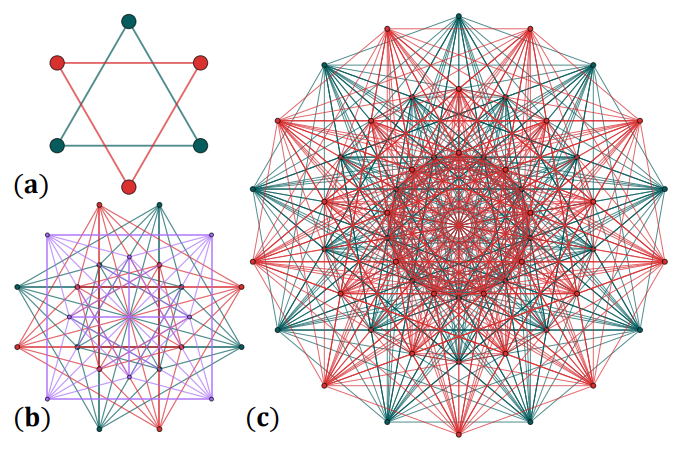
Quantum Spherical Codes
2023-10-25 15:00
Presenter: Shubham
Past Meetings
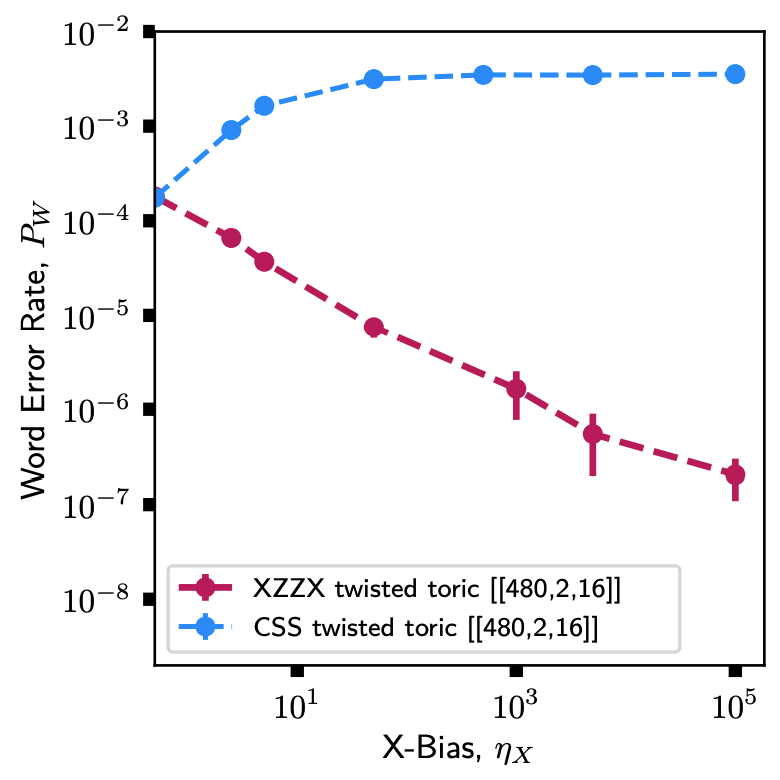
Bias-tailored qLDPC codes
2023-09-13 15:00
Presenter: Eric
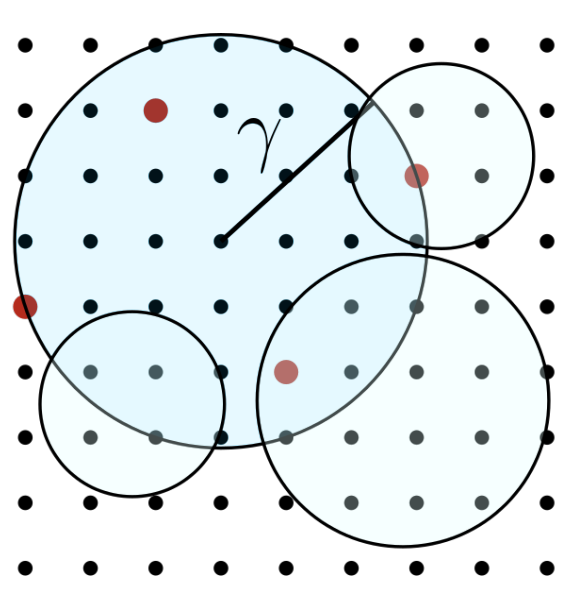
Partial Syndrome Measurement for Hypergraph Product Codes
2023-09-11
Presenter: Noah
Planning Meeting
2023-08-30 15:00
Presenter: N/A
Modular QLDPC Codes
Date: 2022-10-14
Presenter: Noah
Floquet Codes 1
Date: 2022-10-21
Presenter: Eric
Floquet Codes 2
Date: 2022-10-28
Presenter: Eric
Subsystem GKP Codes
Date: 2022-11-11
Presenter: Gideon
Optimal Tomography
Date: 2022-11-18
Presenter: Yonatan
Color code twist defects
Date: 2022-12-02
Presenter: Xiaozhen

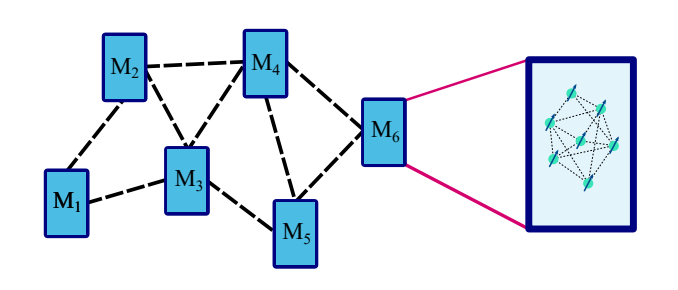
Modular QLDPC Codes
Strikis and Berent, Quantum LDPC Codes for Modular Architectures, 2022
Abstract: In efforts to scale the size of quantum
computers, modularity plays a central role across most
quantum computing technologies. In the light of fault
tolerance, this necessitates designing quantum
error-correcting codes that are compatible with the
connectivity arising from the architectural layouts. In
this paper, we aim to bridge this gap by giving a novel way
to view and construct quantum LDPC codes tailored for
modular architectures. We demonstrate that if the intra-
and inter-modular qubit connectivity can be viewed as
corresponding to some classical or quantum LDPC codes, then
their hypergraph product code fully respects the
architectural connectivity constraints. Finally, we show
that relaxed connectivity constraints that allow twists of
connections between modules pave a way to construct codes
with better parameters.
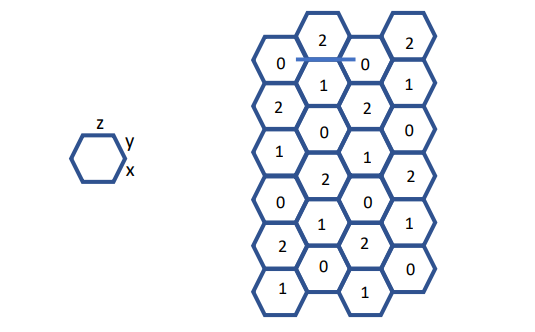
Hastings and Haah, Dynamically Generated Logical Qubits, 2021
Abstract: We present a quantum error correcting code
with dynamically generated logical qubits. When viewed as a
subsystem code, the code has no logical qubits.
Nevertheless, our measurement patterns generate logical
qubits, allowing the code to act as a fault-tolerant
quantum memory. Our particular code gives a model very
similar to the two-dimensional toric code, but each
measurement is a two-qubit Pauli measurement.
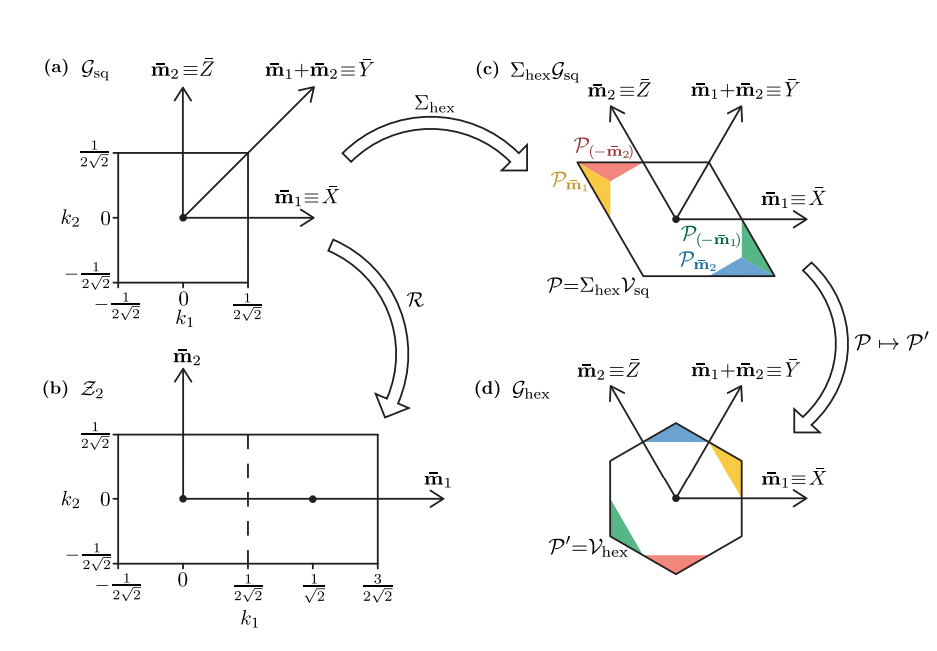
Shaw, Doherty, Grismo,
Stabilizer subsystem decompositions for single- and
multi-mode Gottesman-Kitaev-Preskill codes
The Gottesman-Kitaev-Preskill (GKP) error correcting code
encodes a finite dimensional logical space in one or more
bosonic modes, and has recently been demonstrated in
trapped ions and superconducting microwave cavities. In
this work we introduce a new subsystem decomposition for
GKP codes that we call the stabilizer subsystem
decomposition, analogous to the usual approach to quantum
stabilizer codes. The decomposition has the defining
property that a partial trace over the non-logical
stabilizer subsystem is equivalent to an ideal decoding
of the logical state. We describe how to decompose
arbitrary states across the subsystem decomposition using
a set of transformations that move between the
decompositions of different GKP codes. Besides providing
a convenient theoretical view on GKP codes, such a
decomposition is also of practical use. We use the
stabilizer subsystem decomposition to efficiently
simulate noise acting on single-mode GKP codes, and in
contrast to more conventional Fock basis simulations, we
are able to to consider essentially arbitrarily large
photon numbers for realistic noise channels such as loss
and dephasing.
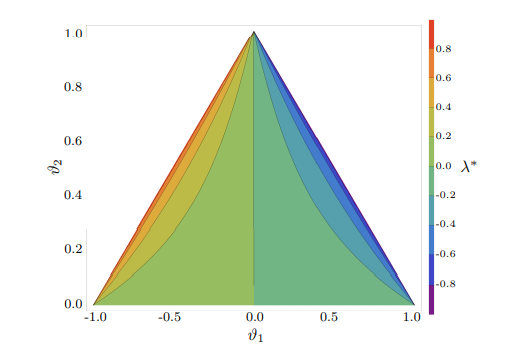
Gazit, Ng, Suzuki, Quantum process tomography via optimal design of experiments, 2019
Quantum process tomography --- a primitive in many quantum
information processing tasks --- can be cast within the
framework of the theory of design of experiment (DoE), a
branch of classical statistics that deals with the
relationship between inputs and outputs of an experimental
setup. Such a link potentially gives access to the many
ideas of the rich subject of classical DoE for use in
quantum problems. The classical techniques from DoE cannot,
however, be directly applied to the quantum process
tomography due to the basic structural differences between
the classical and quantum estimation problems. Here, we
properly formulate quantum process tomography as a DoE
problem, and examine several examples to illustrate the
link and the methods. In particular, we discuss the common
issue of nuisance parameters, and point out interesting
features in the quantum problem absent in the usual
classical setting.
The boundaries and twist defects of the color code and their applications to topological quantum computation
Markus S. Kesselring, Fernando Pastawski, Jens Eisert, and
Benjamin J. Brown
The color code is both an interesting example of an
exactly solvable topologically ordered phase of matter
and also among the most promising candidate models to
realize faul ttolerant quantum computation with minimal
resource overhead. The contributions of this work are
threefold. First of all, we build upon the abstract
theory of boundaries and domain walls of topological
phases of matter to comprehensively catalog the objects
as they are realizable in color codes. Together with our
classification we also provide lattice representations of
these objects which include three new types of boundaries
as well as a generating set for all 72 color code twist
defects. Our work thus provides an explicit toy model
that will help to better understand the abstract theory
of domain walls. Secondly, building upon the established
framework, we discover a number of interesting new
applications of the cataloged objects for devising
quantum information protocols. These include improved
methods for performing quantum computations by code
deformation, a new four-qubit error-detecting code, as
well as families of new quantum errorcorrecting codes we
call stellated color codes, which encode logical qubits
at the same distance as the next best color code, but
using approximately half the number of physical qubits.
To the best of our knowledge, our new topological codes
have the highest encoding rate of local stabilizer codes
with boundedweight stabilizers in two dimensions.
Finally, we show how the boundaries and twist defects of
the color code are represented by multiple copies of
other phases. Indeed, in addition to the well studied
comparison between the color code and two copies of the
surface code, we also compare the color code to two
copies of the three-fermion model. In particular, we find
that this analogy offers a very clear lens through which
we can view the symmetries of the color code which gives
rise to its multitude of domain walls.
Partial Syndrome Measurement for Hypergraph Product Codes
Noah Berthusen, and Daniel Gottesman
Hypergraph product codes are a promising avenue to
achieving fault-tolerant quantum computation with
constant overhead. When embedding these and other
constant-rate qLDPC codes into 2D, a significant number
of nonlocal connections are required, posing difficulties
for some quantum computing architectures. In this work,
we introduce a fault-tolerance scheme that aims to
alleviate the effects of implementing this nonlocality by
measuring generators acting on spatially distant qubits
less frequently than those which do not. We investigate
the performance of a simplified version of this scheme,
where the measured generators are randomly selected. When
applied to hypergraph product codes and a modified
small-set-flip decoding algorithm, we prove that for a
sufficiently high percentage of generators being
measured, a threshold still exists. We also find
numerical evidence that the logical error rate is
exponentially suppressed even when a large constant
fraction of generators are not measured.
Joschka Roffe, Lawrence Z. Cohen, Armanda O. Quintavalle,
Daryus Chandra, Earl T. Campbell
Bias-tailoring allows quantum error correction codes to
exploit qubit noise asymmetry. Recently, it was shown
that a modified form of the surface code, the XZZX code,
exhibits considerably improved performance under biased
noise. In this work, we demonstrate that quantum low
density parity check codes can be similarly
bias-tailored. We introduce a bias-tailored lifted
product code construction that provides the framework to
expand bias-tailoring methods beyond the family of 2D
topological codes. We present examples of bias-tailored
lifted product codes based on classical quasi-cyclic
codes and numerically assess their performance using a
belief propagation plus ordered statistics decoder. Our
Monte Carlo simulations, performed under asymmetric
noise, show that bias-tailored codes achieve several
orders of magnitude improvement in their error
suppression relative to depolarising noise.
Shubham P. Jain, Joseph T. Iosue, Alexander Barg, Victor V. Albert
We introduce a framework for constructing quantum codes
defined on spheres by recasting such codes as quantum
analogues of the classical spherical codes. We apply this
framework to bosonic coding, obtaining multimode
extensions of the cat codes that can outperform previous
constructions while requiring a similar type of overhead.
Our polytope-based cat codes consist of sets of points
with large separation that at the same time form
averaging sets known as spherical designs. We also recast
concatenations of qubit CSS codes with cat codes as
quantum spherical codes.